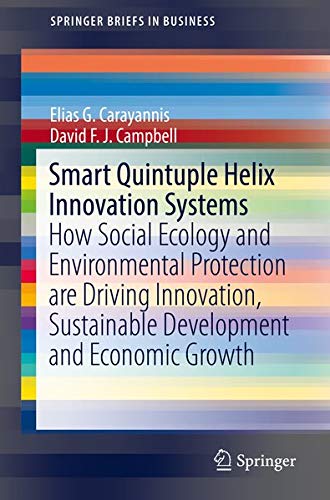
Smart Quintuple Helix Innovation Systems : How Social Ecology and Environmental Protection are Driving Innovation, Sustainable Development and Economic Growth / by Elias G. Carayannis, David F. J. Campbell.
Material type: TextSeries: SpringerBriefs in BusinessPublisher: Cham : Imprint: Springer, Imprint: Springer, 2019Edition: 1st ed. 2019Description: 1 online resource (IX, 67 pages 7 illustrations)Content type:
 - text
- computer
- online resource
- 9783030015176
- 658.514 23
| Cover image | Item type | Current library | Home library | Collection | Shelving location | Call number | Materials specified | Vol info | URL | Copy number | Status | Notes | Date due | Barcode | Item holds | Item hold queue priority | Course reserves | |
|---|---|---|---|---|---|---|---|---|---|---|---|---|---|---|---|---|---|---|
 Books
Books
|
Springfield General stacks | 658.514 (Browse shelf(Opens below)) | Available | LOC-SPL-00019 |
Chapter1. Introduction -- Chapter2. Definition of Key Terms: Knowledge, Knowledge Production, Innovation, Democracy, and Governance -- Chapter3. Mode 1, Mode 2 and Mode 3: Triple Helix and Quadruple Helix -- Chapter4. Sustainable Development, Social Ecology and the Quintuple Helix -- Chapter5. Innovation Systems in Conceptual Evolution: Mode 3 Knowledge Production in Quadruple and Quintuple Helix Innovation Systems -- Chapter6. Conclusion: Smart Quintuple Helix Innovation Systems.-.
This volume examines the relationships among social ecology, innovation, sustainable development and economic growth. Using the principles of Quintuple Helix innovation system, the authors argue that social ecology and environmental management are supporters and drivers of innovation, sustainable development and economic growth. The Quintuple Helix innovation model focuses on the interactions among five key elements of society: academia, industry, government, culture, and the environment--with particular respect to harnessing knowledge to promote social, political, and economic development. The Quintuple Helix is a powerful theoretical and practical lens for analyzing and understanding such critical and complex ecological and socioeconomic issues as global warming and climate change and their implications for sustainability. The authors provide policy approaches and strategies to help create a balance among the often competing forces of environmental protection, innovation, entrepreneurship, and social and economic growth that will successfully benefit society and protect democratic values.
Description based on publisher-supplied MARC data.
There are no comments on this title.